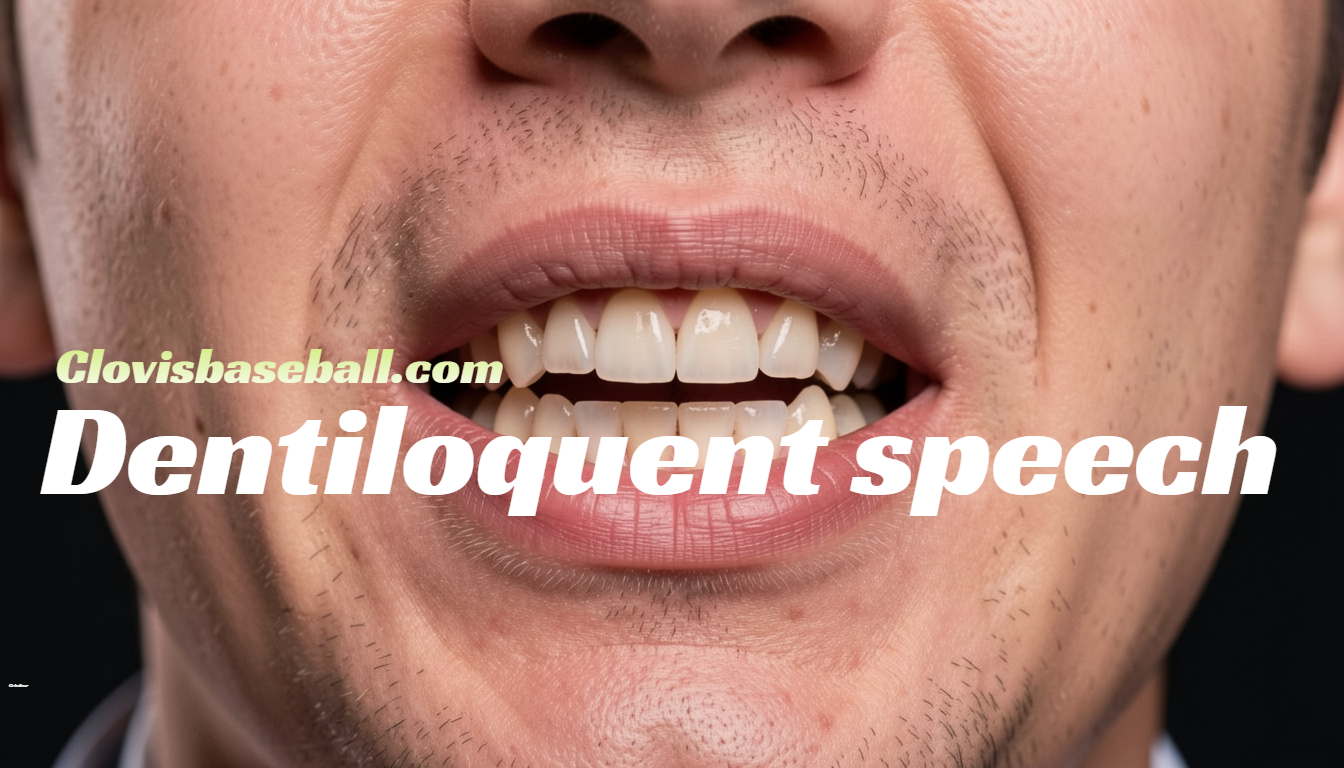
Dentiloquent: The Subtle Art of Speaking Through the Teeth
Dentiloquent speech is a unique style of speaking through the teeth, often with a partially closed jaw or restrained mouth movements. When we think about speech, we usually focus on words—the vocabulary, grammar, or message—but communication is far richer than that. How we articulate, including tone, clarity, and physical mechanisms, profoundly shapes how our message is received. Dentiloquent speech, though rare in everyday language, plays an important role in literature, linguistics, acting, and public speaking, as it conveys subtle emotional and social cues.
Studying such rare speech descriptors allows linguists to analyze sound mechanics, helps writers and actors create more realistic characters, and enhances our understanding of tone, tension, and expression in communication.
Etymology and Origins
The word dentiloquent has its roots in classical Latin, reflecting both the physical and functional aspects of speech. It is derived from two Latin elements:
- “Dens” – meaning tooth
- “Loqui” – meaning to speak
The literal meaning of it is therefore “to speak with teeth”. This emphasizes the physical manner of articulation, rather than the choice of words or overall eloquence.
Historical Use
Dentiloquent speech has appeared in both linguistic studies and literary descriptions over time. Early phonetic and linguistic analyses used the concept to categorize speech patterns based on jaw, teeth, and lip movements. In literature, authors occasionally describe characters as speaking through clenched teeth, subtly communicating tension, frustration, or restraint.
The noun form, dentiloquy, refers to the act of speaking through the teeth, highlighting the habitual or practiced nature of this articulation style.
In terms of comparison, it is one of several Latin-derived descriptors for speech production:
- Labial – speech using the lips
- Guttural – speech produced in the throat
- Nasal – speech resonated through the nose
While these terms describe the source or pathway of sound, dentiloquent specifically highlights the teeth and jaw positioning, making it a unique and precise descriptor for articulation analysis.
Definition and Meaning of Dentiloquent
Formally, it refers to speaking with the teeth partially closed, often producing a distinctive, sharp, biting, or tense sound. It is important to clarify what the speech is and is not:
- It is not about eloquence or vocabulary. A speaker can use simple words or complex sentences; the defining factor is the style of articulation.
- It focuses on the physical mechanics of speech, particularly the teeth and jaw, rather than the content or grammatical correctness of what is being said.
Differences from Similar Speech Patterns
To understand dentiloquence better, it helps to compare it with other articulation styles:
- Labial speech: involves the pronounced use of the lips (e.g., p, b, m sounds).
- Guttural speech: primarily produced in the throat, with a harsher resonance (common in certain languages and accents).
- Nasal speech: sounds resonated through the nasal cavity, often producing a “twang” or nasal quality.
Dentiloquent speech differs because it emphasizes teeth and jaw positioning, subtly altering the quality of sounds without changing the words themselves.
Why Dentiloquence Matters
Even though it may seem minor, the speech carries significant communicative weight:
- Emotional Expression: Can convey tension, frustration, or controlled anger.
- Social Cues: Reveals restraint or authority in dialogue.
- Literary and Performance Value: Adds depth to character portrayal in novels, plays, or performances.
Characteristics of Dentiloquent Speech
Dentiloquent speech can be recognized by several distinct physical and auditory characteristics:
| Feature | Description / Effect |
| Jaw & Teeth | Teeth slightly clenched, minimal jaw movement; adds sharpness and restraint. |
| Lips | Barely parted; muffled sound; conveys control and subtle force. |
| Sound Quality | Sharper, biting, or tense words; consonants “pointed,” vowels restrained. |
| Emotions / Context | Anger, frustration, tension, nervousness, or deliberate emphasis in speech. |
| Visual Cues | Subtle jaw tension; slight teeth movement noticeable. |
| Contrast with Normal Speech | More physically restrained than relaxed open-mouth speech; sounds deliberate and charged. |
Examples of Dentiloquent Speech
Understanding its speech is easier through examples from literature, real life, and practical illustration:
Literary Examples
Authors often describe characters speaking through clenched teeth to convey subtle emotions:
“He spoke in a dentiloquent tone, barely moving his jaw, yet every word carried weight.”
Such literary cues allow readers to infer the character’s emotional state, whether it’s restrained anger, tension, or authority, without explicitly stating it.
Real-Life Examples of Dentiloquent
- Everyday Conversation: Someone speaking under stress or holding back emotion may naturally adopt the articulation.
- Political Speeches or Debates: Controlled, restrained speech can convey authority, resolve, or tension.
- Acting: Actors deliberately use diction to enhance a character’s emotional or psychological state.
Practical Illustration
Consider a sentence spoken:
“We must proceed carefully,” he said, teeth lightly clenched, voice tense but controlled.
The subtle tension of the teeth and jaw communicates as much as the words themselves, making the articulation memorable and impactful.
Phonetic Demonstration
To mimic dentiloquent speech, try this exercise:
- Lightly close your teeth without fully clenching them.
- Keep your lips minimally apart.
- Speak a short sentence slowly, noticing the slightly sharper and restrained sound quality.
- Compare with normal open-mouth speech to hear the difference.
This practical demonstration illustrates how physical mechanics alter sound quality and convey emotion beyond words.
Applications and Relevance of Dentiloquent
Its speech is more than an academic curiosity; it has practical applications across literature, linguistics, acting, and everyday communication. Understanding this subtle style of articulation allows writers, researchers, performers, and communicators to appreciate the nuances of human speech.
Literature and Writing
- Enhancing Character Development: Dentiloquent speech can reveal hidden emotions, tension, or restraint in characters. For instance, a character speaking through clenched teeth may be conveying anger, anxiety, or controlled determination.
- Adding Realism to Dialogue: By describing articulation patterns, writers can make dialogue more vivid and lifelike. Instead of simply writing “he said angrily,” describing the diction conveys emotion through physical speech mechanics.
- Example:
“She replied in a whisper, every word seeming to cut through the silence of the room.”
Linguistics and Phonetics of Dentiloquent
- Studying Articulation Patterns: Dentilquent speech provides a case study in how the position of teeth, jaw, and lips affects sound production. Researchers use it to analyze the subtleties of consonant and vowel articulation.
- Differentiating Speech Types: By comparing speech with labial, guttural, nasal, or lingual speech, linguists can classify speech patterns and understand how physical mechanics influence the clarity and tone of spoken language.
Public Speaking and Acting
- Portraying Tension or Restraint: Actors and speakers use articulation to convey suppressed emotion, tension, or authority. Subtle jaw and teeth positioning can dramatically change the perception of a line.
- Improving Speech Clarity and Emotional Impact: Controlled articulation allows performers and public speakers to emphasize certain words or tones without raising volume, adding depth and nuance to delivery.
Everyday Communication
- Recognizing Subtle Cues: Observing dentiloquent speech in others can help identify emotional states such as stress, restraint, or tension.
- Understanding Emotional States: Subtle differences in speech articulation can signal unspoken feelings, enhancing interpersonal understanding and empathy.
Practice Tips for Dentiloquent
- Position Teeth Slightly Closed: Maintain a natural jaw alignment and avoid full clenching.
- Observe Jaw and Lip Tension: Speak short sentences and notice how subtle tension changes the tone and clarity.
- Compare with Normal Speech: Repeat sentences in normal open-mouth articulation, then listen to hear the differences.
Exercises
- Reading Passages: Pick a short passage from a book and read it with your teeth slightly closed, focusing on precision and restraint.
- Gradual Incorporation: Introduce articulation into everyday expressive speech, practicing varying degrees of jaw and teeth tension.
- Feedback and Recording: Record yourself to analyze the clarity and emotional effect of your speech.
Modern Usage and Frequency of Dentiloquent
Its speech is rare in daily conversation, yet it remains valuable in specific contexts:
- Descriptive Writing: Enhances narrative detail by illustrating speech mechanics.
- Acting and Drama Guides: Trains performers to convey emotions subtly through articulation.
- Phonetics and Linguistic Research: Helps in classifying and studying speech patterns.
Benefits of Understanding Rare Words
- Expands Vocabulary: Knowing terms like dentiloquent enriches language precision.
- Improves Writing and Observation Skills: Allows writers to describe speech nuances more accurately.
- Enhances Communication Awareness: Recognizing articulation styles improves interpersonal understanding and expression.
Even uncommon terms like dentiloquent remain relevant today because they enrich our perception of human speech and refine how we analyze, describe, and perform language.
Conclusion
Its speech represents a unique style of articulation, in which words are spoken through the teeth with minimal mouth movement. Its study spans literature, linguistics, public speaking, acting, and everyday communication, making it both a fascinating and practical concept.
By exploring its origins, characteristics, examples, and applications, we gain insight into how physical speech mechanics influence emotional expression, tone, and clarity. Recognizing and practicing dentiloquent speech can improve writing, enhance performance, refine interpersonal skills, and deepen our understanding of the subtlety of human communication.
Mastering rare speech descriptors like it sharpens both observation and expression, offering a powerful tool to enrich communication, storytelling, and linguistic analysis. Even in modern English, where such terms are seldom used in daily conversation, their value lies in the precision and depth they bring to understanding the art and mechanics of speech.